



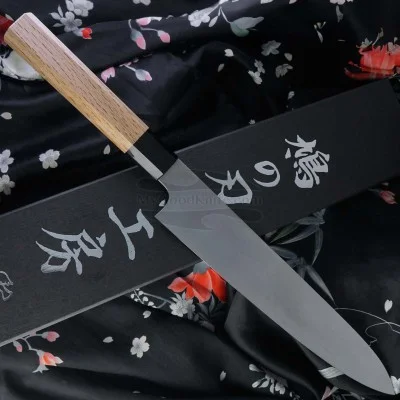


Sujihiki Japanese kitchen knife Kenshiro Hatono KH-3413 24cm
-
Quick shippingWe ship worldwide! If order is placed on business day before 12-00 at Finnish time, we will do our best to ship it on the same day.
-
Easy paymentMyGoodKnife offers several payment options for your purchase: credit card or direct payment to bank account.
-
Secure shoppingMyGoodKnife is secured with SSL (Secure Socket Layer) certificate. Our webshop is encrypted with 128-bit SSL protection. When you move to the payment pages, your payment transaction is completely secure!
-
Customers supportContact our customer service via live chat, e-mail or contact form. We do our best to answer all requests in nearest time.
-
Return & RefundEU customers have the right to cancel order within 14 working days of delivery and return goods for a full refund (except cost of shipment).The goods must be return in saleable (unused) condition including package.
The sujihiki knife is handcrafted by master craftsman Kenshiro Hatono. The 240 mm blade is mirror polished. The blade is made of ZDP-189 steel and the handle is made of oak wood. This knife is suitable for thinly slicing meat, fish, and other foods. It is not dishwasher safe. We recommend using camellia oil to care for Japanese knives. It comes in a branded box.
- Reference
- KH-3413
- Brand
- Kenshiro Hatono
- Country
- Japan
- Steel
- ZDP-189
- Handle
- Oak
- Blade Length, mm
- 240
- Total length, mm
- 380
Kenshiro Hatono was born in Awara City in northern Fukui Prefecture on January 6, 1989. This blacksmith is a student of the legendary master Katsuyasu Kamo from the knife village of Takefu (Echizen). After six years of apprenticeship, he began creating knives under his own name. The master creates knives mainly from Shirogami #1, Aogami Super and SG2 steel. His knives are distinguished by ultra-thin blade geometry and excellent balance. Kenshiro Hatono mainly makes Japanese knives with double-sided sharpening, such as the chef's knife gyuto, nakiri, santoku. The handles are most often made in the traditional Japanese style (wa-handle), using natural woods and stabilized materials.