



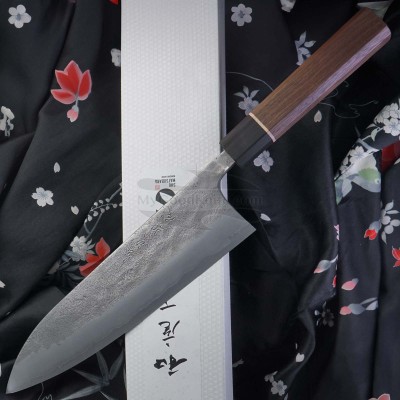


Gyuto Japanese kitchen knife Matsubara Hamono Aogami KT-205 24cm


-
Quick shippingWe ship worldwide! If order is placed on business day before 12-00 at Finnish time, we will do our best to ship it on the same day.
-
Easy paymentMyGoodKnife offers several payment options for your purchase: credit card or direct payment to bank account.
-
Secure shoppingMyGoodKnife is secured with SSL (Secure Socket Layer) certificate. Our webshop is encrypted with 128-bit SSL protection. When you move to the payment pages, your payment transaction is completely secure!
-
Customers supportContact our customer service via live chat, e-mail or contact form. We do our best to answer all requests in nearest time.
-
Return & RefundEU customers have the right to cancel order within 14 working days of delivery and return goods for a full refund (except cost of shipment).The goods must be return in saleable (unused) condition including package.
A chef's knife by master craftsman Katsuto Tanaka, who makes knives under the Matsubara Hamono brand. The 24 cm blade is crafted from three layers. The core is Aogami #2 Blue Paper steel. The traditional Japanese Wa handle is octagonal and made of walnut wood. The knife is not dishwasher safe. It comes in a branded box.
- Reference
- KT-205
- Brand
- Matsubara Hamono
- Country
- Japan
- Steel
- Aogami #2
- Handle
- Walnut
- Blade Length, mm
- 240
- Total length, mm
- 370
Matsubara Hamono is a Japanese knife workshop located in Omura City, Nagasaki Prefecture. The fourth generation of blacksmiths of the Tanaka family, headed by Katsuto Tanaka, continues the centuries-old tradition. In addition to master Katsuto, knives are also made by his son, Hiroki Tanaka, who represents the fifth generation of craftsmen.
Matsubara Hamono craftsmen use traditional forging techniques. The brand is known for using high-quality steels, including Shirogami ("white paper") and Aogami ("blue paper"), as well as modern powder steels such as HAP-40 and ZDP-189.
Matsubara Hamono's range includes various types of Japanese kitchen knives, such as santoku, nakiri, gyuto chef's knife, petti and others. Most blades are made using sanmai technology, with a three-layer structure. This ensures the sharpness and durability of the cutting edge. The workshop continues to evolve, adapting to modern demands, for example, experimenting with new steels and designs.